Let it run on a schedule
Chapter six removed the typing. This one removes the starting. The work is already done when you sit down.
Every job has a set of tasks that are not hard, just relentless. The Monday delivery check. The competitor sweep before the weekly. The scan of what moved in the category. None of them require much thought, all of them require you to remember, and the cost is not the work, it is the fifteen minutes of context-switching to start it.
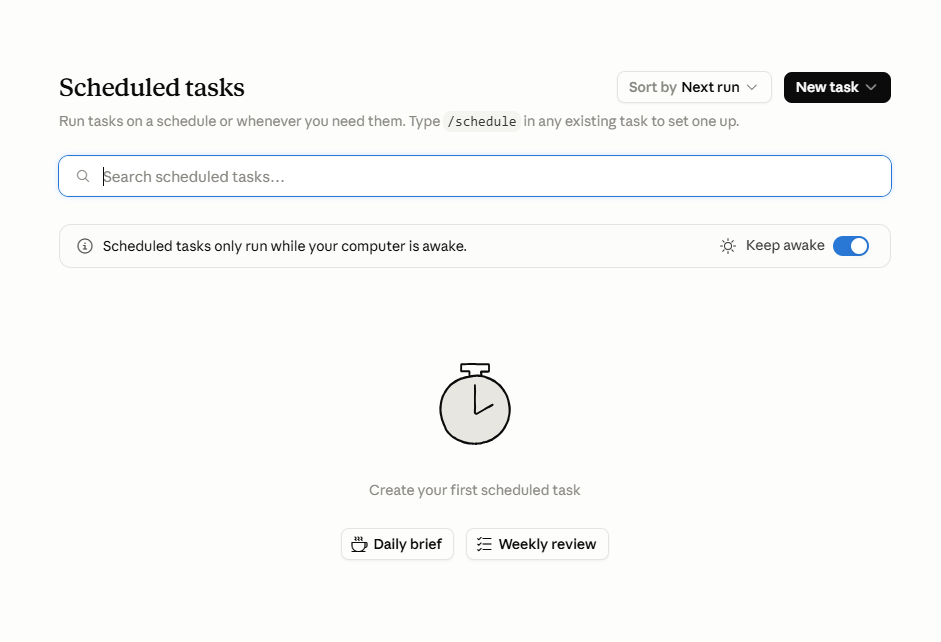
A scheduled task is that job running on its own, on a rhythm you set, so the output is waiting for you rather than queued behind you.
What is actually worth scheduling
The pattern that works: a recurring question with a stable format, where the value is in noticing a change rather than producing an answer.
The common thread is that you would notice if nobody did them, but nobody would ever prioritise them.
What is not worth scheduling
Anything where the answer matters more than the rhythm. Do not schedule the analysis that a client decision rests on, because the point of scheduling is that nobody is watching, and the situations where that is fine are exactly the situations where the stakes are low.
Also be honest about the failure mode. A scheduled report that nobody reads is worse than no report, because it creates a comfortable feeling that something is being monitored. If you have not opened the last three, switch it off rather than letting it accumulate.
Scheduled tasks in the desktop app depend on your machine being awake, so a Monday morning task on a laptop that was shut on Friday will not have run. Cloud-side recurring runs behave differently and are not on every plan. Check which one you have before you build a routine that assumes it.
Start with exactly one
The temptation is to schedule six things in an afternoon and feel enormously productive. A week later none of them are being read.
Pick the single task you most resent doing manually. Set it up, and then actually read the output every time for a month, editing the instructions whenever it gives you something you do not need. What you want at the end is one thing you genuinely rely on, not six you ignore.
This is also the point in the playbook where the earlier chapters compound. A scheduled task is only as good as the instructions behind it, which means it works best when it runs a skill you have already refined, inside a project that already holds the context. Skip those chapters and this one produces confident noise on a timetable.
Name the task you always do late because it is boring. Set that one up to run the morning before you need it. One task, then leave it alone for a month and see whether you actually read it.