Turn a repeated task into one command
A project holds the context for a client. A skill holds the steps for a task. Once you see the difference, you stop retyping instructions forever.
Here is the test. If you have written out the same long set of instructions three times, for three different brands, changing only the name at the top, you are doing a machine's job by hand.
A skill is a saved instruction set that turns a multi-step task into a one-line command. That is the whole idea.
The distinction worth holding on to: One is who you are working for. The other is how a particular job gets done. You will often use both at once.a project holds the context for a client, a skill holds the steps for a task.
What it replaces
Take competitive research, which is the clearest example because it is genuinely the same job every time.
Done by hand, you paste something like this on every brand: define the category and the main competitors, then for each competitor cover positioning, channel mix and recent campaigns; profile the audience including media habits and platform preferences; pull category benchmarks for cost and engagement; identify three opportunities and three risks; return it as a structured brief with sources against every claim.
That is a good instruction set. It also takes five minutes to type and you will not type it identically twice, which means your outputs are not comparable across brands.
Saved as a skill, it becomes: run the market research skill on this brand. Same steps, same structure, every time, which is what makes the results worth comparing at all.
Where they live
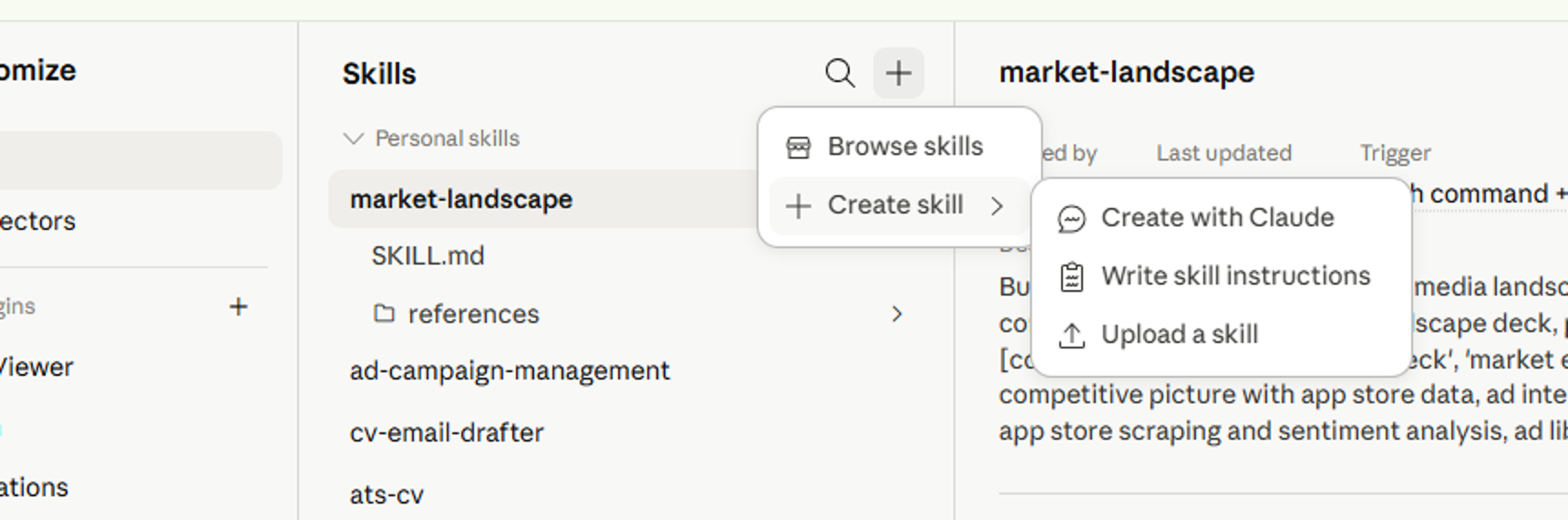
You have three routes to a new one. Browse what already exists, describe the task and have it written for you, or write the instructions yourself. For a first skill, describing the task out loud and letting it draft the instructions is by far the fastest way in.
The two worth building first
Do not start with something ambitious. Start with something tedious that you already do, because the value is in the repetition, not the complexity.
The first version will be roughly right. The value comes from editing it every time it misses something. When it forgets to include sources, add that line. When it gives you five options and you only ever want three, change it. After a month of small corrections it encodes how you actually work, and that accumulated judgment is the real asset, not the original draft.
The honest limitation
Skills are worth it for tasks with a stable shape. Competitive scans, briefs, reviews, recurring reports, anything with steps you could describe to a new joiner.
They are not worth it for genuine thinking. Strategy, the creative leap, the judgment call about whether this client will actually buy this idea: those are different every time and encoding them just gives you a formula that produces the same mediocre answer reliably. Automate the shape of the work, not the thinking inside it.
Look at what you did last week and find the task you did more than twice. Describe it out loud, in order, as if training someone on their first day, and have that turned into a skill. Then run it on something real and fix the first thing it gets wrong.