Where do you score on AI nativity?
From chatting with AI to a brain that works while you sleep. Five levels, a two minute test.
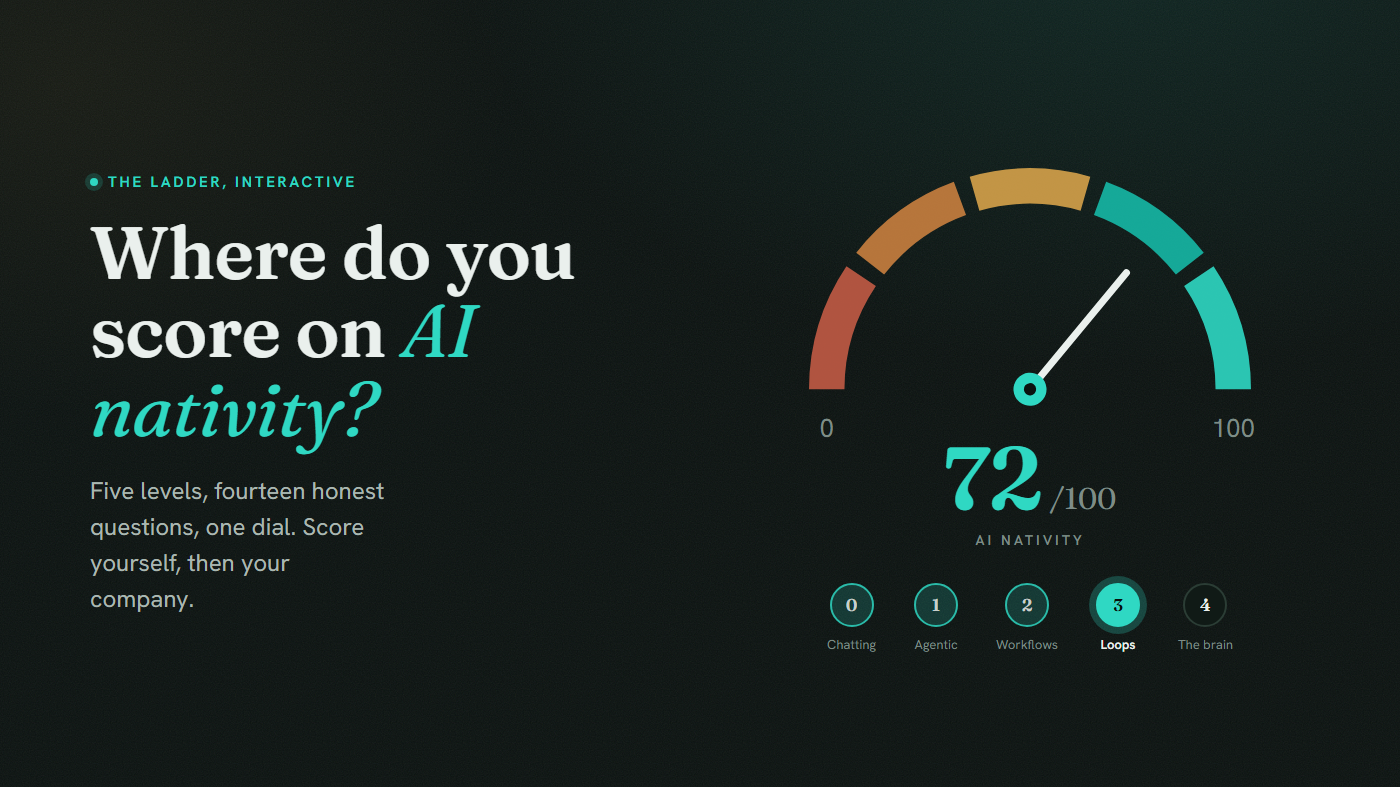
Do you know where you sit on the "AI nativity" scale?
Everyone says they are AI native. Here is a way to actually measure it.
The honest measure is not licences, and not the AI slide in the company deck. It is the distance between chatting with AI and having AI run parts of your work without you. Almost everyone sits somewhere on that line. Very few know where.
Two things happened in the past two years that most people missed.
First, capability moved out of the chat box. OpenAI shipped Operator, agent mode, and this July a work agent that delivers finished documents across 1,400 connected apps. Anthropic shipped Claude Code, scheduled agents and Cowork. The tools stopped waiting for your next message.
Second, the quiet race: memory and context. Context windows grew from two thousand tokens in 2020 to over a million today, both labs shipped persistent memory in 2025, and Andrej Karpathy now runs his research as a wiki the model writes and maintains itself. The frontier moved from what the model can say to what your setup can remember.
Almost nobody moved with it. McKinsey found 88 percent of companies use AI somewhere, and only around 6 percent get real value at scale. Of roughly 900 million weekly ChatGPT users, about ten million have touched its agent products. One percent.
The money noticed. Anthropic overtook OpenAI in enterprise AI spend on the back of agents, OpenAI's enterprise revenue passed its consumer side this summer, and with governments now regulating the top models directly, the advantage is shifting to what you build around the model: memory, context and compute. The model is becoming the commodity. The setup is the advantage.
A simple test: what did AI do for you last night while you slept? For me: an agent gathered the day's AI news, my reading feed refreshed, and my status board rebuilt itself from my notes. Nothing impressive on its own. But for most of my career, the honest answer was nothing.
That is the scale. Five levels:
- Level 0, chatting. You ask, it answers, you move the useful parts by hand. Nothing happens unless you are there.
- Level 1, agentic work. You hand over a complete task with context, tools and a clear definition of done. You review instead of assemble.
- Level 2, workflows. The process is defined once and repeats with the same quality. The business owns it, not one person.
- Level 3, loops. Work starts itself on a schedule or a trigger and continues overnight.
- Level 4, the brain. Agents and workflows share one memory: from chat context to projects and folders to databases to a full brain. What you learned last month changes this month on its own.
If you are still here :D I turned the five levels into a two minute test. It scores you, it scores your company, and it checks how deep your memory setup goes. Take it, see where you both stand, and look at the gap between the two numbers. That gap is the most useful part.