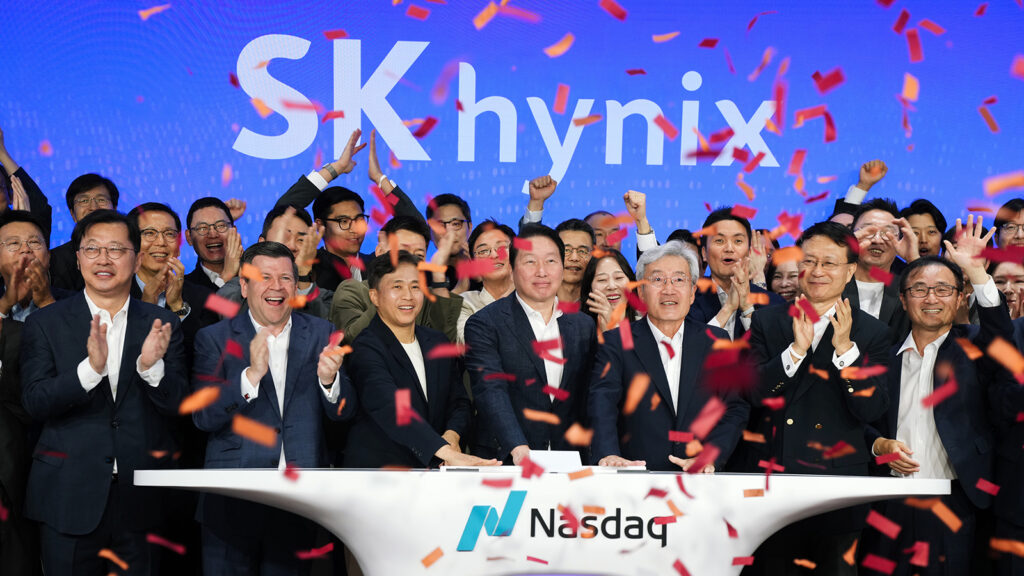
SK hynix began trading American Depositary Receipts on Nasdaq on July 10, ringing the opening bell at the exchange's MarketSite in Times Square at 9:30 a.m. Eastern, the company said in its newsroom. SK Group Chairman Chey Tae-won and SK hynix CEO Kwak Noh-Jung led the ceremony, and the company marked the debut by taking over more than 40 digital screens around Times Square in a roadblock campaign running through July 13.
This is not a cosmetic cross-listing. The ADRs are backed by newly issued common shares, which makes the debut a capital raise as well as a market entry. The offering is scheduled to close on July 14 Eastern time, and the new underlying shares will be additionally listed on Korea's KOSPI market on July 29. Until now, anyone wanting exposure to the world's leading high bandwidth memory maker had to buy Seoul-listed stock, with the currency and access friction that entails. From this week, the position is a plain dollar-denominated Nasdaq trade.
The company was explicit about why. The listing, it said, is meant to expand its global investor base, lower barriers for international investors, and tie the firm more tightly to the American AI ecosystem, where it has "established a significant competitive edge in High Bandwidth Memory (HBM), the core component of AI accelerators." Kwak framed the moment in his bell-ceremony remarks as the culmination of a 25-year turnaround from near bankruptcy, closing with the line that will headline every investor deck from here: "AI will be everywhere, and SK hynix will be wherever AI is."
Why it matters: HBM is the binding constraint of the AI buildout. Every leading accelerator ships with stacks of it, supply is sold out quarters ahead, and SK hynix holds the strongest position in the segment. A Nasdaq listing puts the scarcest layer of the AI hardware stack directly inside the world's deepest capital pool, and the new-share structure means the company walks away with fresh funding for the capacity race against Samsung and Micron at exactly the moment demand is steepest. It also signals that Korea's AI champions now see a US listing as table stakes for staying close to their biggest customers.
For the Gulf, the link is capital access. Sovereign and institutional investors in Riyadh and Abu Dhabi building AI-infrastructure portfolios trade US markets far more easily than KOSPI. The memory layer that gates every regional data-center buildout, from Humain's campuses to G42's clusters, is now a standard Nasdaq line item rather than a Korean market workaround.
The takeaway: investors gain clean, liquid exposure to the HBM bottleneck and should watch the July 14 offering close for sizing. Operators and builders should read the raise as more HBM capacity funding, which is good news for anyone whose 2027 roadmap depends on accelerator supply. Samsung and Micron should read it as an escalation: the market-share fight in AI memory is now also a fight for Wall Street's money.