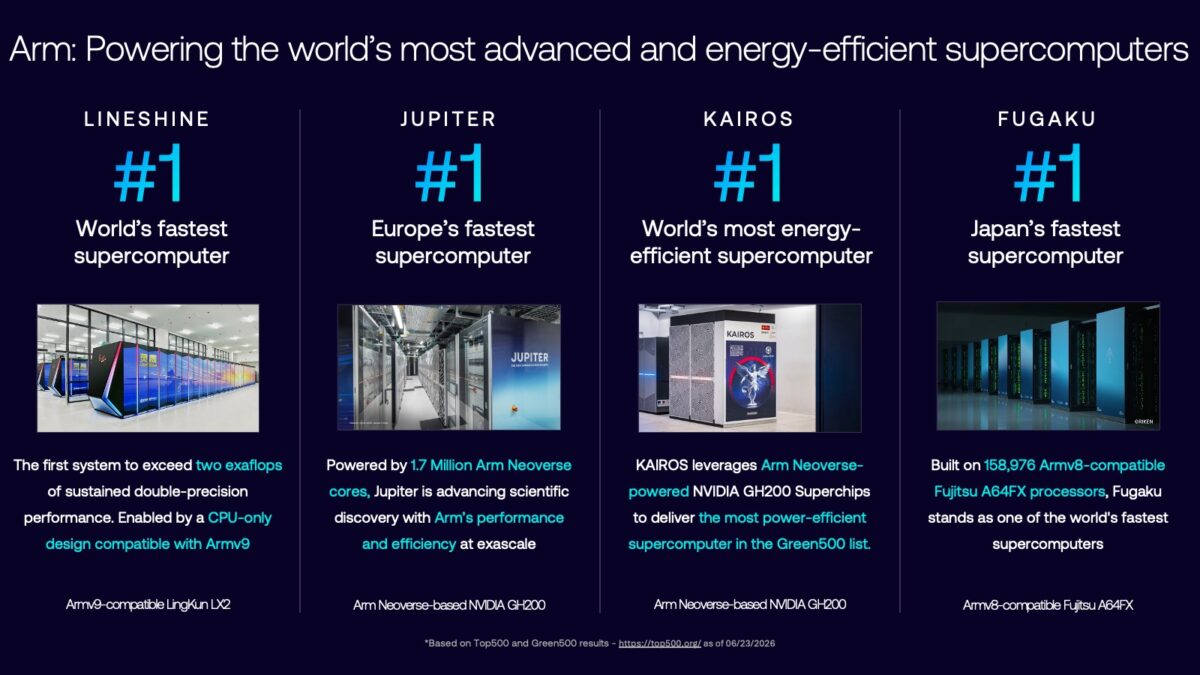
Arm announced through its newsroom that its architecture now powers some of the world's most advanced and energy-efficient supercomputers. This development is reshaping the landscape of high-performance computing (HPC) by delivering exceptional performance and efficiency for AI-driven workloads.
At the core of this progress is Arm's Neoverse architecture, which supports systems achieving unprecedented benchmarks in performance and energy efficiency. A highlight is the LineShine supercomputer, which leads the TOP500 as the first system to exceed two exaflops of sustained double-precision performance, operating on Armv9 architecture without reliance on GPUs. Additionally, Arm-based systems dominate the Green500 list with their top energy efficiency, with NVIDIA Grace-based systems holding the top four spots.
The significance of this achievement lies in the intersection of HPC and AI. As these fields converge, the demands placed on computing resources grow. Arm's architecture offers solutions that scale effectively, maintaining the delicate balance between power, performance, and cost efficiency. Notably, JUPITER, Europe's first exascale supercomputer, showcases how Arm's technology can tackle complex scientific and industrial challenges with nearly 24,000 NVIDIA GH200 Grace Hopper Superchips using 1.7 million Arm Neoverse cores.
The Gulf region, with its focus on sustainable and high-tech advancements, stands to gain from these developments. The ability to scale AI and compute-heavy workloads more efficiently becomes increasingly relevant as sectors like energy, finance, and smart cities look to leverage supercomputing for innovation and problem-solving.
Practically, Arm's advancements open doors for a range of stakeholders. Organizations requiring robust computational power can leverage Arm-based solutions for superior performance and energy efficiency. Investors eyeing the growing convergence of AI and HPC can find lucrative opportunities as demand for sustainable, high-performance computing technologies rises. While traditional chip manufacturers might feel competitive pressure, the ecosystem that Arm fosters—including collaborations with NVIDIA and others—signals that partnership is key to harnessing AI's full potential.